When anxiety first entered my life, I didn’t recognize it right away. I just knew something felt wrong. I would sit quietly, yet my mind felt loud. My chest felt tight, my thoughts wouldn’t slow down, and no matter how hard I tried, I couldn’t explain what was happening inside me. Every time someone asked, “Are you okay?”
I wanted to answer honestly, but I didn’t have the words. That’s when I started turning my feelings into metaphors. I told myself, “This feels like a storm in my head,” or “It’s like my mind is running without brakes.” Those simple comparisons changed everything.
They helped me understand my anxiety instead of fighting it, and they helped me explain it without fear or shame. That’s why I believe metaphors for anxiety matter so much because when I learned to describe what I was feeling, I finally learned how to handle it.
20 Metaphors for Anxiety
1. Anxiety is a storm inside my head
- Meaning: Overwhelming thoughts and emotions
- Explanation: Everything feels loud, chaotic, and uncontrollable
- Examples:
- My anxiety felt like a storm inside my head before the meeting.
- When I’m anxious, my thoughts thunder nonstop.
2. Anxiety is a racing engine with no brakes
- Meaning: Constant mental overthinking
- Explanation: Your mind won’t slow down even when you need rest
- Examples:
- My brain runs like a racing engine with no brakes at night.
- Anxiety keeps my thoughts speeding.
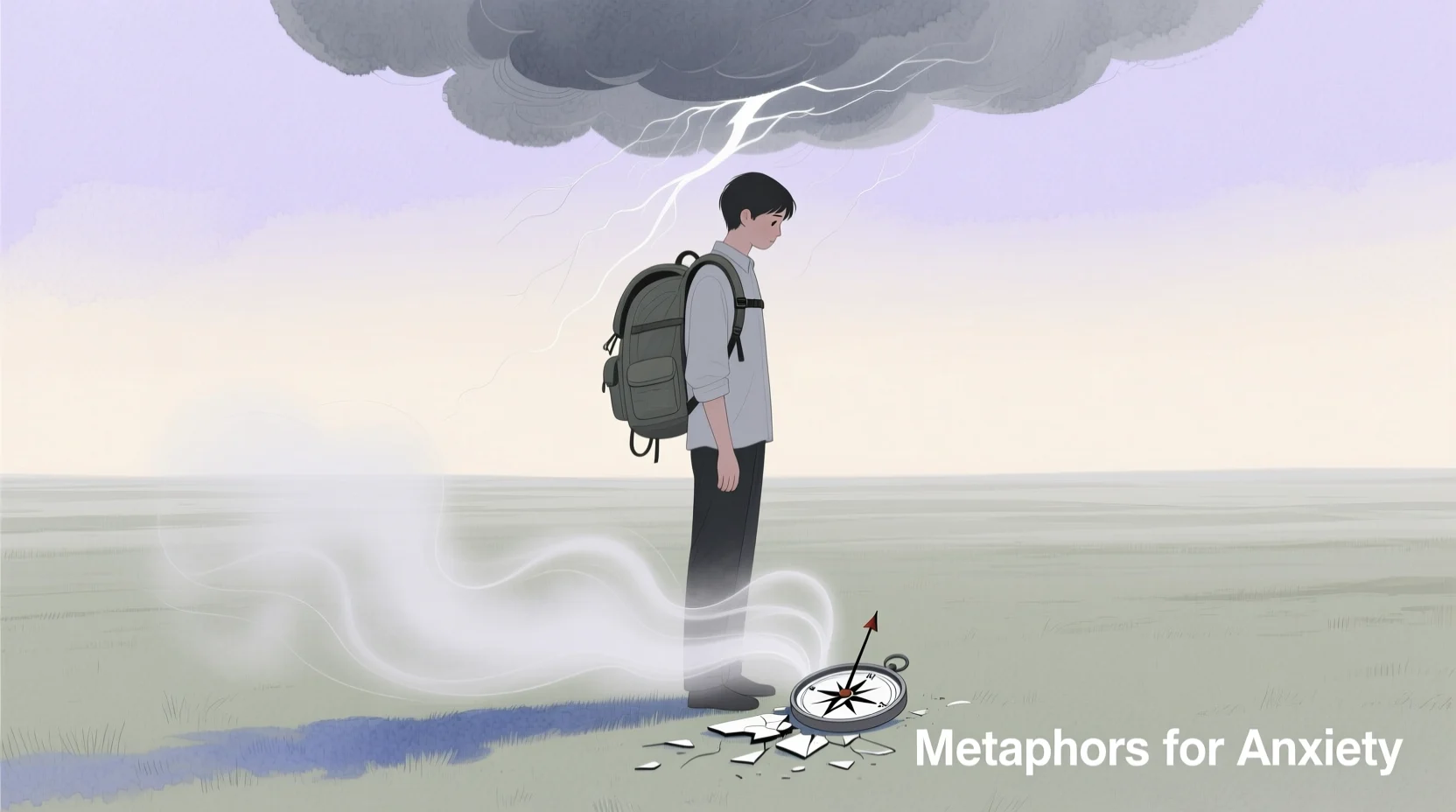
3. Anxiety is carrying a heavy backpack
- Meaning: Emotional burden
- Explanation: You feel weighed down all the time
- Examples:
- I carry anxiety like a heavy backpack everywhere.
- Even simple tasks feel heavy with anxiety on my shoulders.
4. Anxiety is a smoke alarm that won’t stop
- Meaning: Constant false danger signals
- Explanation: Your body reacts even when nothing is wrong
- Examples:
- My anxiety screams like a broken smoke alarm.
- It warns me of danger that isn’t there.
5. Anxiety is quicksand
- Meaning: Feeling stuck
- Explanation: The more you fight it, the deeper you sink
- Examples:
- Anxiety feels like quicksand when I panic.
- Struggling only pulls me deeper.
6. Anxiety is static on a radio
- Meaning: Mental noise
- Explanation: It blocks clarity and calm thinking
- Examples:
- Anxiety fills my mind with static.
- I can’t hear calm thoughts clearly.
7. Anxiety is a tight knot in my chest
- Meaning: Physical tension
- Explanation: Emotional stress shows up in the body
- Examples:
- Anxiety ties my chest in knots.
- I feel it tighten when stress rises.
8. Anxiety is a shadow that follows me
- Meaning: Persistent presence
- Explanation: It’s always there, even in good moments
- Examples:
- Anxiety follows me like a shadow.
- It never fully leaves.
9. Anxiety is walking on thin ice
- Meaning: Fear of making mistakes
- Explanation: Every step feels risky
- Examples:
- Conversations feel like thin ice when I’m anxious.
- I fear slipping constantly.
10. Anxiety is a buzzing fly
- Meaning: Constant irritation
- Explanation: Small but impossible to ignore
- Examples:
- Anxiety buzzes in my mind all day.
- I can’t swat it away.
11. Anxiety is a locked door
- Meaning: Feeling blocked
- Explanation: It stops progress or expression
- Examples:
- Anxiety locks my words inside.
- I feel trapped behind it.
12. Anxiety is an overpacked calendar
- Meaning: Mental overwhelm
- Explanation: Too many worries at once
- Examples:
- My anxiety fills every mental slot.
- There’s no space to rest.
13. Anxiety is a siren in my chest
- Meaning: Panic response
- Explanation: Sudden intense fear
- Examples:
- Anxiety sounds like a siren inside me.
- It blares without warning.
14. Anxiety is fog
- Meaning: Confusion
- Explanation: Hard to think clearly
- Examples:
- Anxiety fogs my decisions.
- Everything feels unclear.
15. Anxiety is holding my breath
- Meaning: Constant tension
- Explanation: You never fully relax
- Examples:
- Anxiety feels like holding my breath all day.
- Relief comes only when I exhale.
16. Anxiety is a spinning wheel
- Meaning: Repetitive thoughts
- Explanation: The same worries loop endlessly
- Examples:
- My anxiety spins the same thoughts.
- I can’t stop the loop.
17. Anxiety is an uninvited guest
- Meaning: Lack of control
- Explanation: It shows up without permission
- Examples:
- Anxiety crashes my peace uninvited.
- It overstays its welcome.
18. Anxiety is a tight grip
- Meaning: Loss of ease
- Explanation: It squeezes comfort away
- Examples:
- Anxiety grips my body tightly.
- I struggle to relax.
19. Anxiety is a broken compass
- Meaning: Loss of direction
- Explanation: Decisions feel uncertain
- Examples:
- Anxiety breaks my inner compass.
- I doubt every choice.
20. Anxiety is drowning in shallow water
- Meaning: Overreaction to manageable problems
- Explanation: It feels dangerous even when it’s not
- Examples:
- Anxiety makes me drown in shallow worries.
- Small problems feel overwhelming.
Conclusion
Anxiety feels far less powerful when I can understand it and put it into words. The moment I describe it using a metaphor, it stops being an invisible force and becomes something I can face.
Sometimes it feels like a storm, sometimes like a broken alarm, but I remind myself that anxiety is not who I am it is simply something I experience.
Metaphors don’t make anxiety disappear, but they make it lighter, easier to talk about, and less frightening to carry alone. When I can name what I’m feeling, its grip slowly loosens, and that’s where a sense of calm truly begins.
Practical Exercise: Understanding Your Anxiety (10 Q&A)
1. What metaphor fits my anxiety best?
→ The one that feels emotionally accurate.
2. Does anxiety always feel the same?
→ No, it changes with situations.
3. Can metaphors reduce anxiety?
→ Yes, understanding lowers fear.
4. Why does naming anxiety help?
→ It creates distance and clarity.
5. Should I share my metaphor with others?
→ Yes, it improves communication.
6. Can I create my own metaphor?
→ Absolutely, personal ones work best.
7. Do physical metaphors help more?
→ Often, because anxiety lives in the body.
8. Can metaphors help in therapy?
→ Yes, they deepen insight.
9. Should I journal using metaphors?
→ Yes, it helps process emotions.
10. Does anxiety define me?
→ No, it’s an experience, not your identity.

Calara Brant is a writer at Mitaphare.com. On the site, she creates articles full of vivid and meaningful metaphors helping readers see common feelings, places, or ideas in new ways. Her work transforms everyday things into powerful images and invites readers to think deeply about life, feelings, and experiences.