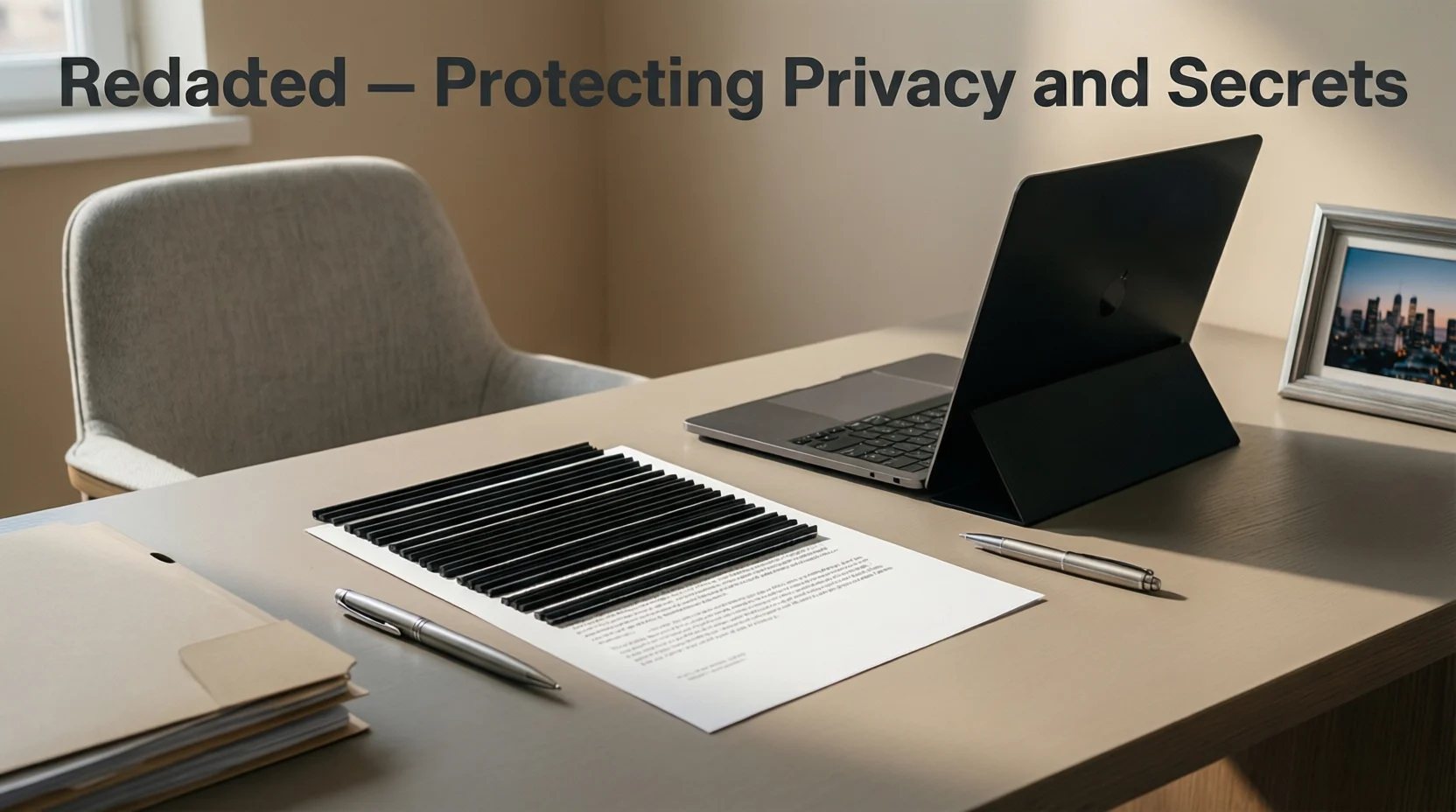
Have you ever seen a document with black lines hiding words?
Some names. Some numbers and some sentences.
It looks strange at first.
It looks like a secret.
That is called redacted.
It is a word used when information is removed or hidden.
Governments, lawyers, and reporters use it a lot.
I have seen redacted documents many times.
Some were serious. Some were simple.
Every time, I wanted to know what it meant.
Now, I will explain it to you.
What Does Redacted Mean?
Redacted means text or information is hidden or removed.
It is done before people see the document.
For example:
- A government report may hide people’s names.
- A legal document may hide addresses or phone numbers.
Redacted is not the same as deleted.
Deleted means it is gone forever.
Redacted means it is hidden but still there in a safe place.
The Literal Meaning and Origin
The word redact comes from Latin.
“Redactus” means brought back or edited.
Redacted is the past form.
It means edited to hide private or secret information.
It is a serious word.
Often used in law, government, and media.
Why Do People Redact Documents?
Redaction has a purpose.
It keeps private information safe.
It protects people and countries and
it prevents legal problems.
For example:
- A court may redact a witness’s name.
- A company may redact a client’s data.
Without redaction, secrets could leak.
Without redaction, people could be in danger.
Where Do We See Redacted Documents?
Redaction appears in many places:
- Government papers – like reports, emails, or investigations.
- Legal documents – court papers, contracts, filings.
- Media – newspapers, online articles, investigations.
- Academic research – sometimes private data must be hidden.
Everywhere you need privacy or safety, redaction may appear.
The Tone of Redacted Documents
Redacted documents are serious.
They are not casual.
They are professional.
The tone is neutral, not angry or funny.
Black lines or hidden text tell readers:
“This information is sensitive.”
“Handle with care.”
Synonyms of Redacted
Some words mean something similar:
- Censored – often used for movies or media.
- Blacked out – usually literal, like a line over text.
- Obscured – hidden from view.
- Hidden – kept from being seen.
Redacted is a professional way to say it.
It is used in official documents.
Examples of Redacted Information
Here are some examples:
Government report:
- Names of agents are redacted.
- Locations of operations are redacted.
Court case:
- Witness addresses are redacted.
- Phone numbers are redacted.
News article:
- Identity of victims is redacted.
- Sensitive locations are redacted.
Redaction keeps people safe and laws followed.
How to Redact Properly
Redaction must be done carefully.
You cannot just use a marker randomly.
Steps to redact:
- Identify sensitive information.
- Use proper software or tools.
- Cover or block text completely.
- Check the document for mistakes.
- Save a safe copy of the original.
Digital redaction is different from paper redaction.
Paper uses black markers.
Digital uses software to hide text.
Common Misunderstandings
Some people think redaction is censorship.
It is not always censorship.
Censorship tries to hide ideas or opinions.
Redaction hides personal or secret data.
Some think redacted documents are illegal.
They are not.
Redaction follows laws and rules.
Redacted in Digital vs Paper Documents
Paper documents:
- Use markers or cut-outs.
- Physically block sensitive info.
Digital documents:
- Use PDF tools or software.
- Hide text securely so no one can recover it.
Digital redaction is faster and safer.
Redaction and Privacy
Redaction protects privacy.
Without it, personal data can leak.
People could get in trouble.
Companies could lose trust.
For example:
- A leaked phone number could be misused.
- A leaked address could cause danger.
Redaction is simple but powerful.
Redaction in Law and Government
It is very common in law.
Courts use it to protect witnesses.
Lawyers use it to protect clients.
Governments use it to protect secrets.
Classified information is always redacted.
Redaction helps balance transparency and safety.
Redaction in Media and Journalism
Journalists also redact.
They hide names, addresses, and other private info.
It is part of responsible reporting.
Redaction shows care.
It tells readers: “We respect privacy.”
Tools to Redact Documents
For digital documents:
- PDF editors (Adobe Acrobat, Nitro)
- Word processors with redaction features
- Specialized software for sensitive data
For paper documents:
- Black markers
- Scissors for clipping
- Transparent covers for sensitive text
Always double-check redaction.
Even small mistakes can reveal private info.
Why Redaction Matters Today
Life is digital now.
Documents move online.
Leaks happen easily.
Redaction is more important than ever.
It protects identity.
It protects organizations and
it protects countries.
How Redaction Protects You
Redaction keeps secrets safe.
It prevents identity theft.
It avoids legal problems and
it helps organizations follow rules.
Even small redactions can prevent big mistakes.
Redacted as a Life Lesson
Redaction teaches carefulness.
It reminds us to respect privacy.
It shows that some things should not be shared publicly.
Even in small ways, it is important to hide sensitive information.
Conclusion
Redacted is a word that carries weight.
It is more than black lines on a page.
It is about safety, privacy, and professionalism.
Redaction is simple but powerful.
It teaches us to be careful with information.
It is a small step that keeps the world safer.
Next time you see blacked-out lines, you will know:
That information is redacted, and it is for a good reason.
FAQs About Redacted
1. How to redact a document safely?
Use software or tools designed for redaction. Check twice. Never leave hidden info visible.
2. Can redacted documents be unredacted?
Sometimes yes, if redaction is done poorly. Proper tools make it permanent.
3. Is redaction the same as censorship?
No. Redaction hides private info. Censorship hides ideas or opinions.
4. Where is redaction most commonly used?
Courts, governments, media, and companies often redact documents.
5. Why is redacted text blacked out instead of deleted?
It shows something was there. It protects the original while hiding sensitive parts.

James Wallet is a writer who focuses on emotional clarity, self-improvement, and practical insights. His writing style is direct, relatable, and easy to follow. Through his work on Metaphare.com, James aims to help readers better understand their emotions and build a healthier mindset.James Wallet is a writer who focuses on emotional clarity, self-improvement, and practical insights. His writing style is direct, relatable, and easy to follow. Through his work on Metaphare.com, James aims to help readers better understand their emotions and build a healthier mindset.