I still remember those nights when sleep felt like a stranger. I would lie in bed, eyes closed, but my mind stayed wide awake. It was as if sleep was a train that passed my station every night, and I was left standing on the platform.
I tried counting sheep. I tried deep breathing. Nothing worked. That’s when I realized something important. I was fighting sleep instead of understanding it.
One night, instead of forcing myself to sleep, I started thinking about sleep in a different way. I told myself that sleep is not a switch you turn off. It is more like a gentle wave. You don’t chase a wave. You let it carry you.
That small change in thinking helped me relax. My body softened. My thoughts slowed down. Sleep slowly walked back into my life.
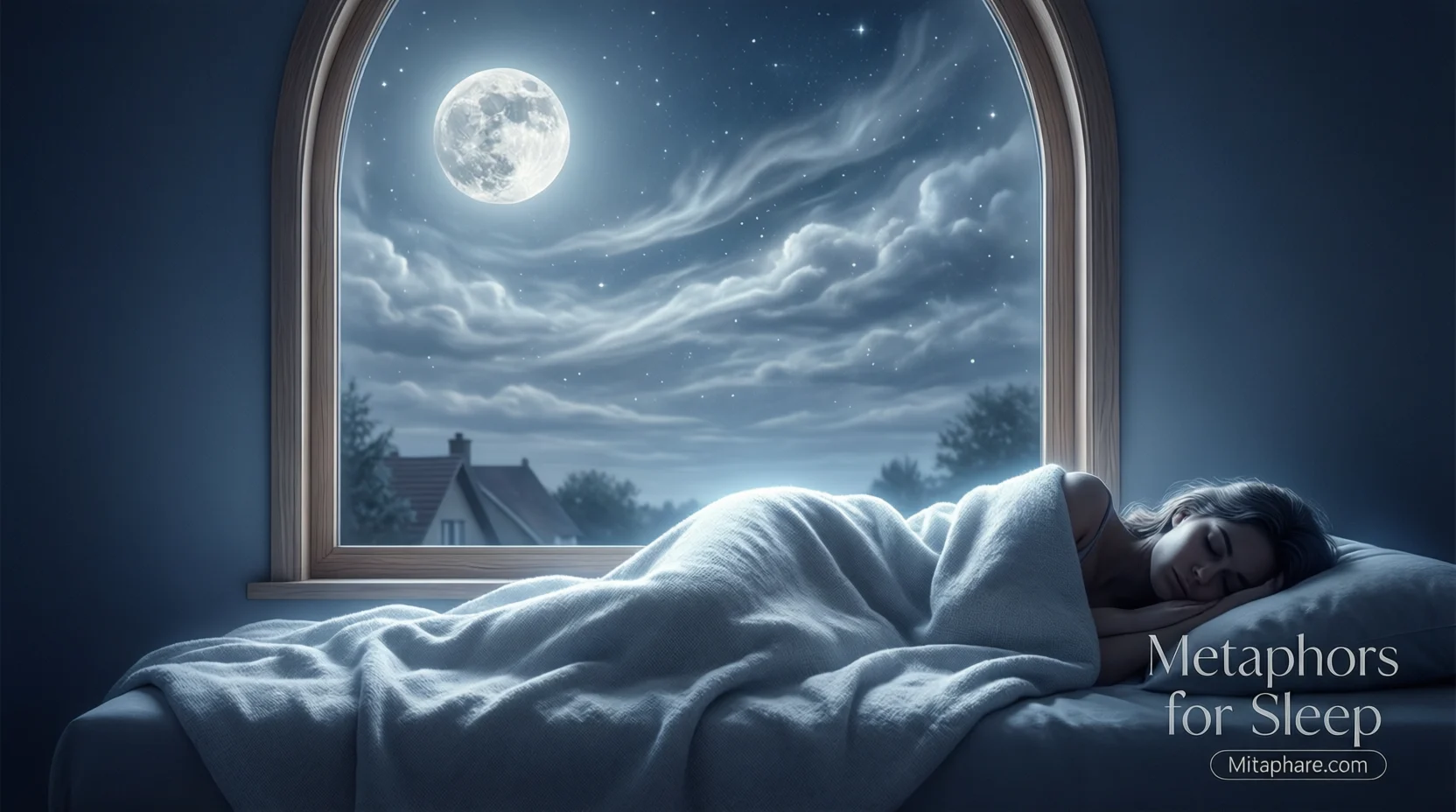
Since then, I’ve learned that metaphors make sleep easier to understand. When I think of sleep as a soft blanket, a quiet river, or a dimming light, my mind stops racing. I stop stressing and stop blaming myself. I simply let go.
20 Metaphors for Sleep
1. Sleep Is a Soft Blanket
Metaphor (in use):
Sleep wrapped me like a soft blanket.
Meaning:
Sleep feels comforting and protective.
Explanation:
Just like a blanket gives warmth and safety, sleep offers emotional and physical comfort.
Examples:
- After a long day, sleep wrapped me like a soft blanket.
- I pulled the covers up and let sleep become my blanket.
2. Sleep Is a Quiet Harbor
Metaphor (in use):
Sleep became my quiet harbor.
Meaning:
Sleep is a safe place to rest.
Explanation:
A harbor protects ships from storms, just as sleep protects us from stress.
Examples:
- After the chaos, sleep was my quiet harbor.
- I sailed into sleep’s calm harbor.
3. Sleep Is a Falling Leaf
Metaphor (in use):
I fell asleep like a leaf drifting down.
Meaning:
Sleep happens gently and naturally.
Explanation:
A leaf doesn’t rush it slowly lets go, like drifting into sleep.
Examples:
- My thoughts slowed, and I slept like a falling leaf.
- He drifted into sleep, light and slow.
4. Sleep Is a Shut Curtain
Metaphor (in use):
Sleep pulled the curtain on my day.
Meaning:
Sleep ends waking life for the night.
Explanation:
Like closing a curtain, sleep closes awareness.
Examples:
- Sleep pulled the curtain on my busy thoughts.
- I let sleep shut the curtain gently.
5. Sleep Is a Deep Ocean
Metaphor (in use):
I sank into a deep ocean of sleep.
Meaning:
Sleep is deep and immersive.
Explanation:
The ocean suggests depth, stillness, and total immersion.
Examples:
- I sank into the deep ocean of sleep.
- She disappeared beneath waves of sleep.
6. Sleep Is a Pause Button
Metaphor (in use):
Sleep pressed pause on my worries.
Meaning:
Sleep temporarily stops stress and effort.
Explanation:
Like pausing a video, sleep gives life a break.
Examples:
- Sleep pressed pause on my racing mind.
- I needed sleep to pause everything.
7. Sleep Is a Gentle Thief
Metaphor (in use):
Sleep stole me away.
Meaning:
Sleep arrives quietly and unexpectedly.
Explanation:
Sleep often comes without us noticing.
Examples:
- Sleep stole me mid-thought.
- I didn’t notice when sleep took me.
8. Sleep Is a Warm Cave
Metaphor (in use):
I crawled into sleep like a warm cave.
Meaning:
Sleep feels sheltered and safe.
Explanation:
A cave protects from outside noise and danger.
Examples:
- Sleep felt like hiding in a warm cave.
- I rested inside sleep’s quiet cave.
9. Sleep Is a Gentle Wave
Metaphor (in use):
Sleep washed over me.
Meaning:
Sleep comes gradually and smoothly.
Explanation:
Waves arrive naturally, just like sleep.
Examples:
- Sleep washed over me slowly.
- A wave of sleep carried her away.
10. Sleep Is a Locked Door
Metaphor (in use):
Sleep locked the door on the world.
Meaning:
Sleep disconnects us from our surroundings.
Explanation:
A locked door blocks noise and awareness.
Examples:
- Sleep locked the door on my thoughts.
- I closed my eyes and locked the door.
11. Sleep Is a Reset
Metaphor (in use):
Sleep reset my mind.
Meaning:
Sleep restores energy and clarity.
Explanation:
Like resetting a device, sleep refreshes us.
Examples:
- Sleep reset everything.
- I woke up fully reset.
12. Sleep Is a Gentle Surrender
Metaphor (in use):
I surrendered to sleep.
Meaning:
Sleep requires letting go.
Explanation:
Fighting sleep keeps us awake; surrender invites it.
Examples:
- I finally surrendered to sleep.
- She stopped resisting and slept.
13. Sleep Is a Night Train
Metaphor (in use):
Sleep carried me away like a night train.
Meaning:
Sleep takes us to another mental place.
Explanation:
Dreams feel like traveling.
Examples:
- Sleep took me on a night train.
- I boarded sleep without noticing.
14. Sleep Is a Dimmer Switch
Metaphor (in use):
Sleep slowly dimmed my thoughts.
Meaning:
Awareness fades gradually.
Explanation:
Like lights dimming, thoughts soften.
Examples:
- Sleep dimmed my busy mind.
- Everything grew quieter inside.
15. Sleep Is a Safe Cocoon
Metaphor (in use):
Sleep wrapped me in a cocoon.
Meaning:
Sleep protects and restores.
Explanation:
A cocoon suggests healing and rest.
Examples:
- I slept inside a cocoon of calm.
- Sleep wrapped me tightly.
16. Sleep Is a Silent Song
Metaphor (in use):
Sleep sang me quiet.
Meaning:
Sleep soothes the mind.
Explanation:
Like a lullaby, sleep calms us.
Examples:
- Sleep sang me into dreams.
- A silent song carried me off.
17. Sleep Is a Gentle Fall
Metaphor (in use):
I fell softly into sleep.
Meaning:
Sleep arrives without force.
Explanation:
The fall is calm, not sudden.
Examples:
- I fell softly into sleep.
- He drifted down gently.
18. Sleep Is a Closed Book
Metaphor (in use):
Sleep closed today’s book.
Meaning:
The day has ended.
Explanation:
A book closing signals completion.
Examples:
- Sleep closed the book on my day.
- I turned the final page.
19. Sleep Is a Hidden World
Metaphor (in use):
Sleep opened a hidden world.
Meaning:
Dreams feel magical and unknown.
Explanation:
Sleep takes us somewhere unseen.
Examples:
- Sleep opened a hidden world.
- Dreams carried me elsewhere.
20. Sleep Is a Gentle Friend
Metaphor (in use):
Sleep stayed by my side.
Meaning:
Sleep supports healing and comfort.
Explanation:
A friend brings peace and care.
Examples:
- Sleep stayed with me all night.
- I trusted sleep like a friend.
Conclusion
Sleep is more than just closing your eyes at night. It is comfort, rest, and a quiet escape from the noise of the day. Using metaphors for sleep helps us explain feelings that are hard to describe with plain words. Whether sleep feels like a soft blanket, a deep ocean, or a gentle friend, these images make our writing warmer and more relatable.
When you use these metaphors, your words become more vivid and meaningful. So the next time you talk or write about sleep, choose a metaphor and let your reader feel the calm, peace, and rest that sleep truly brings.
Practical Exercise: Practice Using Sleep Metaphors
Questions & Answers
- Q: Which metaphor shows comfort?
A: Sleep is a soft blanket. - Q: Which metaphor suggests safety?
A: Sleep is a quiet harbor. - Q: Which metaphor shows gradual rest?
A: Sleep is a gentle wave. - Q: Which metaphor means mental refresh?
A: Sleep is a reset. - Q: Which metaphor describes deep sleep?
A: Sleep is a deep ocean. - Q: Which metaphor shows ending the day?
A: Sleep is a closed book. - Q: Which metaphor suggests dreams?
A: Sleep is a hidden world. - Q: Which metaphor shows letting go?
A: Sleep is a gentle surrender. - Q: Which metaphor shows quiet arrival?
A: Sleep is a gentle thief. - Q: Which metaphor feels protective?
A: Sleep is a safe cocoon.

William Jones is an American author known for his clear, engaging, and reader-friendly writing style. He enjoys turning everyday ideas into meaningful stories that are easy to understand and enjoyable to read. His work often focuses on simple language, strong metaphors, and practical lessons that connect directly with readers.
With a passion for storytelling, William believes that good writing doesn’t need to be complicated to be powerful. He aims to make ideas feel familiar, relatable, and memorable. Whether he’s explaining a concept, sharing a story, or exploring human behavior, his goal is always clarity and connection.
When he’s not writing, William enjoys reading classic literature, observing everyday life for inspiration, and helping readers see common things in a new way.