I still remember the moment when anxiety first hit me hard. I was sitting quietly, thinking everything was normal, when my chest suddenly felt tight and my thoughts started racing. Someone asked me what was wrong, and I didn’t know how to explain it. I wasn’t sick. Nothing bad had happened. I just felt off. That’s when I realized how difficult it is to talk about anxiety when you don’t have the right words.
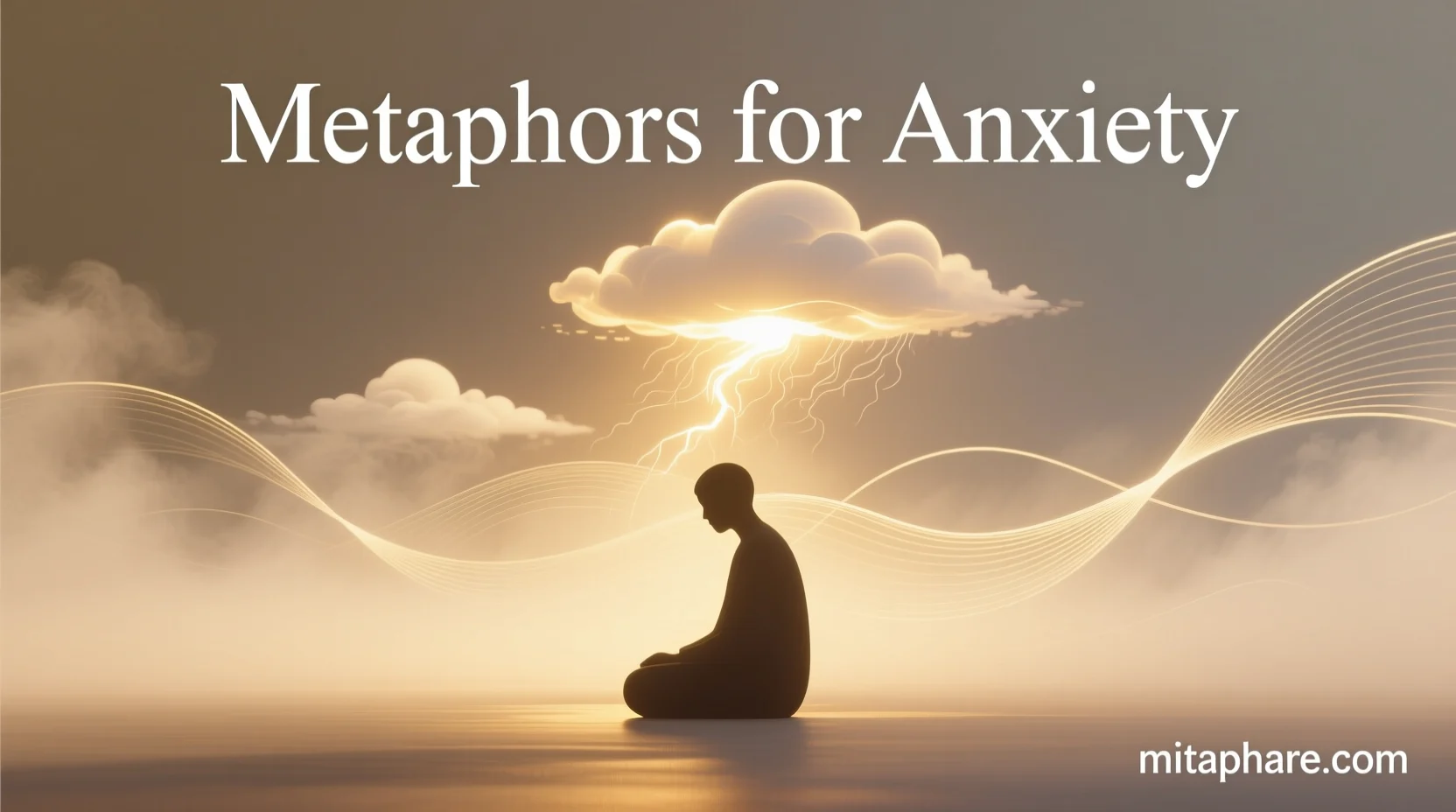
What helped me was learning to describe my anxiety instead of fighting it. I started using metaphors. Some days it felt like a storm stuck inside my head. Other days it felt like carrying a heavy weight I couldn’t put down. When I explained it this way, people understood me better and more importantly, I understood myself. Giving anxiety a shape and a name made it feel less overwhelming.
That’s why I’m sharing these metaphors for anxiety. They’re not just creative phrases. They’re the exact tools I used to handle my own anxious moments, make sense of my feelings, and remind myself that I wasn’t broken I was human.
20 Metaphors for Anxiety
1. Anxiety is like a storm that won’t move on
Meaning: Ongoing emotional turmoil
Explanation: Storms are loud, overwhelming, and hard to ignore—just like anxiety.
Examples:
- My anxiety felt like a storm hovering over my head all day.
- Even small worries became thunder during that storm.
2. Anxiety is a buzzing alarm that never turns off
Meaning: Constant alertness
Explanation: Anxiety keeps your body in danger mode, even when nothing is wrong.
Examples:
- My mind was a buzzing alarm at 3 a.m.
- I wanted silence, but the alarm kept ringing.
3. Anxiety is carrying an invisible backpack full of rocks
Meaning: Emotional burden
Explanation: You look fine, but the weight slows you down.
Examples:
- I smiled, but my backpack of rocks was heavy.
- Every task felt harder with that weight.
4. Anxiety is a treadmill that won’t stop
Meaning: Endless mental activity
Explanation: You keep moving but never arrive anywhere.
Examples:
- My thoughts ran on a treadmill all night.
- No matter how fast I ran, I stayed stuck.
5. Anxiety is a fog over clear thoughts
Meaning: Mental confusion
Explanation: Anxiety clouds judgment and focus.
Examples:
- Simple choices disappeared in the fog.
- I couldn’t see past my anxious thoughts.
6. Anxiety is a radio stuck on static
Meaning: Mental noise
Explanation: It’s hard to hear calm thoughts through the noise.
Examples:
- My brain played static all day.
- Peaceful thoughts couldn’t get through.
7. Anxiety is a clenched fist in my chest
Meaning: Physical tension
Explanation: Anxiety often shows up in the body.
Examples:
- A clenched fist sat in my chest.
- Breathing felt tight and shallow.
8. Anxiety is a broken smoke detector
Meaning: False danger signals
Explanation: It reacts even when there’s no fire.
Examples:
- My anxiety went off for no reason.
- I panicked, but nothing was wrong.
9. Anxiety is quicksand made of thoughts
Meaning: Mental overwhelm
Explanation: Struggling makes you sink deeper.
Examples:
- The more I fought it, the deeper I sank.
- One thought pulled me under.
10. Anxiety is a movie stuck on the worst scene
Meaning: Catastrophic thinking
Explanation: Your mind replays fear on repeat.
Examples:
- My mind replayed the worst ending.
- I couldn’t fast-forward to calm.
11. Anxiety is a tightrope without a safety net
Meaning: Fear of failure
Explanation: Everything feels risky.
Examples:
- Each decision felt like a tightrope.
- One slip felt fatal.
12. Anxiety is a shadow that follows me
Meaning: Persistent worry
Explanation: It’s always there, even in good moments.
Examples:
- Joy came, but the shadow stayed.
- I couldn’t outrun it.
13. Anxiety is a locked door with no key
Meaning: Feeling trapped
Explanation: You want relief but can’t access it.
Examples:
- Calm felt locked away.
- I searched for a key that wasn’t there.
14. Anxiety is a drum beating too fast
Meaning: Racing heart and thoughts
Explanation: Everything feels rushed and intense.
Examples:
- My chest beat like a wild drum.
- I couldn’t slow the rhythm.
15. Anxiety is a tangled ball of yarn
Meaning: Complicated emotions
Explanation: Thoughts are knotted together.
Examples:
- My feelings were tangled tight.
- I didn’t know where to start.
16. Anxiety is a voice that whispers worst-case stories
Meaning: Negative self-talk
Explanation: Anxiety feeds fear quietly.
Examples:
- The voice told me I’d fail.
- It sounded convincing.
17. Anxiety is a cracked mirror
Meaning: Distorted perception
Explanation: Reality looks worse than it is.
Examples:
- I saw myself through cracks.
- Everything looked broken.
18. Anxiety is holding my breath without realizing it
Meaning: Constant tension
Explanation: You don’t relax naturally.
Examples:
- I forgot how to breathe.
- Calm felt unnatural.
19. Anxiety is a suitcase I never unpack
Meaning: Carrying unresolved stress
Explanation: Old worries stay with you.
Examples:
- I dragged my anxiety everywhere.
- I never unpacked it.
20. Anxiety is a false fire drill
Meaning: Panic without real danger
Explanation: Your body reacts to imagined threats.
Examples:
- My heart raced for nothing.
- The drill felt real anyway.
Conclusion
Anxiety can make you feel lost and alone, but it doesn’t mean something is wrong with you. I’ve learned that when I stop fighting anxiety and start describing it, its power slowly fades. Metaphors help turn heavy, confusing feelings into something I can see, name, and understand.
When I can say, “This feels like a storm” or “My mind is stuck on a treadmill,” I’m no longer trapped inside the fear I’m observing it. And that small shift matters.
You don’t need perfect calm or all the answers right now. Even recognizing what you feel is progress. Be kind to yourself. You’re handling more than you realize.
Practical Exercise: Using Metaphors to Understand Your Anxiety
1. Question: Why do metaphors help with anxiety?
Answer: They make feelings easier to understand and explain.
2. Question: Can metaphors reduce anxiety?
Answer: Yes, naming it often reduces fear.
3. Question: Should I pick one metaphor?
Answer: Start with one that feels most accurate.
4. Question: Can metaphors change over time?
Answer: Absolutely. Anxiety changes, so metaphors do too.
5. Question: Can I create my own metaphor?
Answer: Yes, personal metaphors work best.
6. Question: How do I explain anxiety to others?
Answer: Share a metaphor instead of a diagnosis.
7. Question: Do metaphors replace therapy?
Answer: No, but they support understanding.
8. Question: Can kids use anxiety metaphors?
Answer: Yes, they’re very effective for children.
9. Question: Should I write my metaphor down?
Answer: Writing helps process emotions.
10. Question: What if no metaphor fits?
Answer: That’s okay create one slowly.

Marton Jones is a writer who focuses on emotions, self-awareness, and meaningful content. His writing style is simple, clear, and reader-friendly, making complex ideas easy to understand. Through his work on Metaphare.com, Marton shares thoughtful insights that help readers connect with their feelings and improve personal understanding.