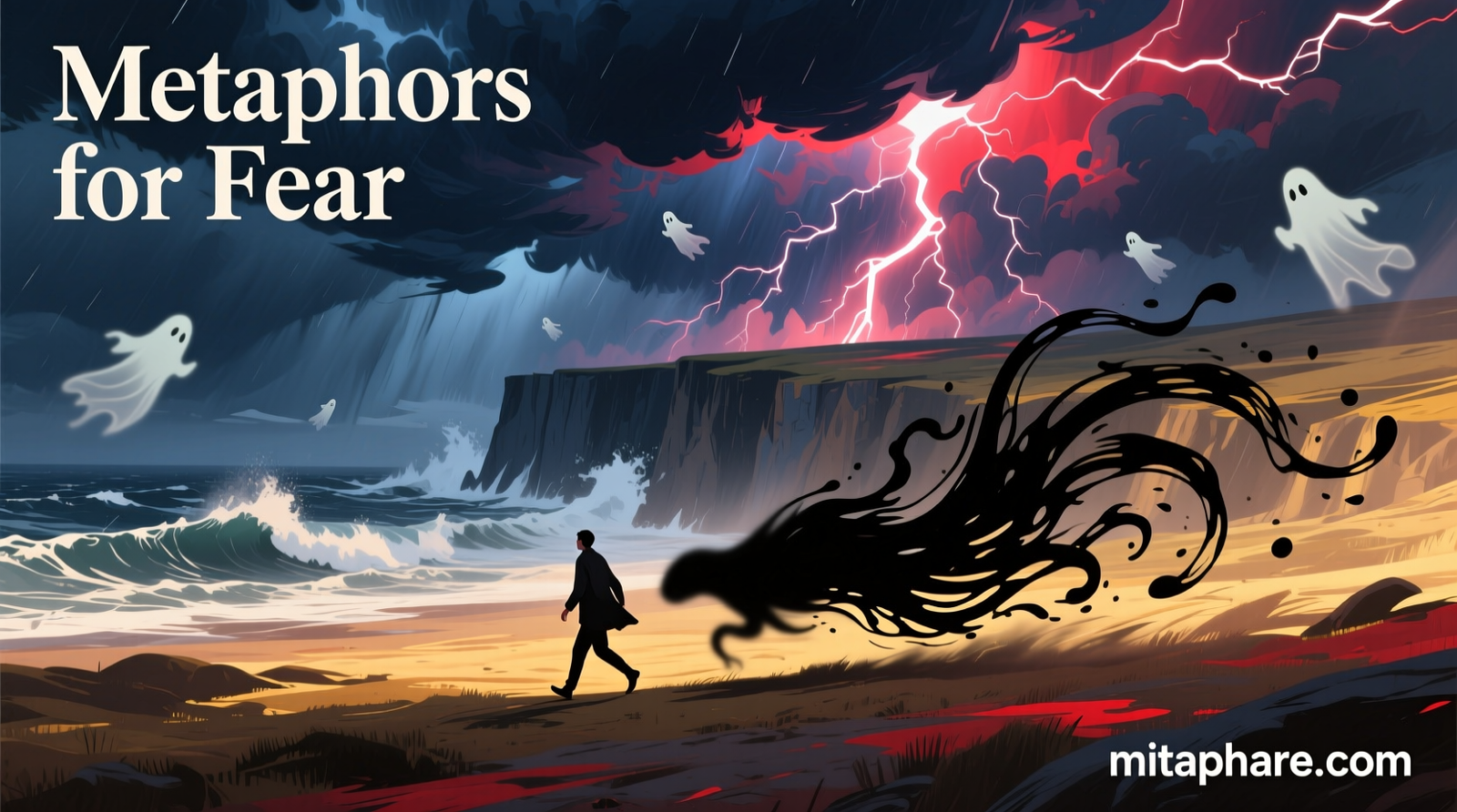
Hey, let’s be honest—fear is something we all feel. Sometimes it’s a quick shiver when watching a horror movie. Other times, it’s that heavy, tight feeling in your chest before giving a big presentation. But saying “I’m scared” can get boring. That’s where metaphors for fear come in—they let you express fear in a more vivid, creative way. Think of it as painting your feelings with words instead of just stating them. Today, I’m going to share 20 powerful metaphors for fear and show you exactly how to use them.
20 Metaphors for Fear
1. Fear is a shadow
Meaning: Fear follows you silently.
Explanation: Like a shadow, fear lingers and moves with you, always present even if unseen.
Examples:
- “Fear is a shadow that never leaves my side.”
- “Even in the bright room, a shadow of fear crept along my thoughts.”
2. Fear is a cage
Meaning: Fear traps you.
Explanation: It keeps you from acting or moving freely.
Examples:
- “Her fear was a cage, holding her back from speaking up.”
- “He stared at the opportunity, trapped in a cage of fear.”
3. Fear is a cold hand
Meaning: Fear makes you feel physically tense.
Explanation: It grips you suddenly, making your body react.
Examples:
- “A cold hand of fear clenched his heart.”
- “The thought of failure felt like a cold hand on her shoulder.”
4. Fear is a storm
Meaning: Fear is overwhelming and chaotic.
Explanation: Like a storm, it sweeps through your mind with force.
Examples:
- “A storm of fear rattled her thoughts.”
- “Fear hit him like a sudden storm at sea.”
5. Fear is a ghost
Meaning: Fear can be invisible but haunting.
Explanation: Even when you don’t see it, it lingers and bothers you.
Examples:
- “The ghost of fear whispered doubts in his mind.”
- “She felt a ghost of fear watching over her decisions.”
6. Fear is a tightrope
Meaning: Fear makes you feel unstable or cautious.
Explanation: Walking a tightrope requires care, just like facing fear.
Examples:
- “Fear had him walking a tightrope between action and hesitation.”
- “Every decision felt like balancing on a tightrope of fear.”
7. Fear is a cage of ice
Meaning: Fear freezes you.
Explanation: It prevents action, leaving you stuck.
Examples:
- “He stood frozen, trapped in a cage of ice fear.”
- “Fear turned her hands to ice, unable to move.”
8. Fear is a dark tunnel
Meaning: Fear feels endless and isolating.
Explanation: Like a tunnel, it can seem never-ending.
Examples:
- “He was lost in a dark tunnel of fear.”
- “The dark tunnel of fear made her doubt every step.”
9. Fear is quicksand
Meaning: Fear slowly pulls you down.
Explanation: The more you struggle, the deeper you sink.
Examples:
- “Panic felt like quicksand dragging him deeper.”
- “Her fear was quicksand, pulling her confidence away.”
10. Fear is a wildfire
Meaning: Fear spreads fast.
Explanation: Once it starts, it consumes your thoughts quickly.
Examples:
- “Rumors sparked a wildfire of fear across the office.”
- “Fear spread through the village like wildfire.”
11. Fear is a locked door
Meaning: Fear blocks opportunities.
Explanation: Like a door that won’t open, it keeps you from moving forward.
Examples:
- “Fear was a locked door she couldn’t open.”
- “His fear blocked every chance to try something new.”
12. Fear is a stormy sea
Meaning: Fear feels unpredictable.
Explanation: Waves of fear toss you around emotionally.
Examples:
- “She navigated a stormy sea of fear before the interview.”
- “His thoughts were waves in a stormy sea of fear.”
13. Fear is a snake
Meaning: Fear strikes suddenly.
Explanation: Like a snake, it surprises and scares.
Examples:
- “Fear slithered through his mind like a snake.”
- “The snake of fear struck when he least expected it.”
14. Fear is a tight knot
Meaning: Fear creates tension.
Explanation: Like a knot, it ties up your muscles and thoughts.
Examples:
- “A tight knot of fear formed in her stomach.”
- “Fear tied him in a tight knot, unable to speak.”
15. Fear is a creeping vine
Meaning: Fear slowly grows and spreads.
Explanation: It entangles you little by little.
Examples:
- “A creeping vine of fear wrapped around his mind.”
- “The vine of fear grew with every failure he imagined.”
16. Fear is a frozen lake
Meaning: Fear immobilizes you.
Explanation: You can’t move without breaking through it.
Examples:
- “Her courage cracked like ice on a frozen lake of fear.”
- “He felt stuck, standing on a frozen lake of fear.”
17. Fear is a dark cloud
Meaning: Fear overshadows everything.
Explanation: Like a cloud, it blocks light and happiness.
Examples:
- “A dark cloud of fear hung over him.”
- “Her thoughts were shadowed by a dark cloud of fear.”
18. Fear is a ticking clock
Meaning: Fear makes time feel urgent or tense.
Explanation: Like a clock ticking, it creates anxiety.
Examples:
- “The ticking clock of fear reminded him of the deadline.”
- “Fear ticked in her mind like a relentless clock.”
19. Fear is a maze
Meaning: Fear confuses and traps you.
Explanation: Like a maze, it’s hard to find a way out.
Examples:
- “He wandered in a maze of fear and doubt.”
- “Fear turned her mind into a confusing maze.”
20. Fear is a shadowy figure
Meaning: Fear is intimidating and mysterious.
Explanation: Like a figure in the dark, it’s scary because it’s unknown.
Examples:
- “A shadowy figure of fear loomed behind him.”
- “She faced a shadowy figure of fear she couldn’t name.”
Conclusion
Fear is something everyone experiences, but it doesn’t have to be boring to describe. Using metaphors for fear lets you express it vividly and creatively, whether in writing, storytelling, or even daily conversation. From shadows to wildfires, each metaphor paints a picture of the feeling in a way simple words cannot. Next time you want to describe fear, try one of these 20 metaphors—you’ll make your writing more engaging and your emotions more relatable.
Practical Exercise: Using Metaphors for Fear
Try these 10 questions to practice your understanding. Answers included.
- Q: Which metaphor describes fear that traps you physically?
A: Fear is a cage. - Q: Which metaphor describes fear that spreads quickly?
A: Fear is a wildfire. - Q: Which metaphor represents fear that is invisible but haunting?
A: Fear is a ghost. - Q: Which metaphor describes fear making you freeze?
A: Fear is a cage of ice. - Q: Which metaphor describes fear that confuses you?
A: Fear is a maze. - Q: Which metaphor represents fear that creates tension in your body?
A: Fear is a tight knot. - Q: Which metaphor describes fear that follows you silently?
A: Fear is a shadow. - Q: Which metaphor describes fear that immobilizes you?
A: Fear is a frozen lake. - Q: Which metaphor describes fear that surprises suddenly?
A: Fear is a snake. - Q: Which metaphor represents fear that blocks opportunities?
A: Fear is a locked door.

Daren Jones is an American author who writes about emotions, self-growth, and meaningful storytelling. His work focuses on explaining complex feelings in a simple and relatable way. Through his writing on Metaphare.com, he helps readers better understand their thoughts, manage emotions, and connect with ideas that inspire clarity and personal growth.