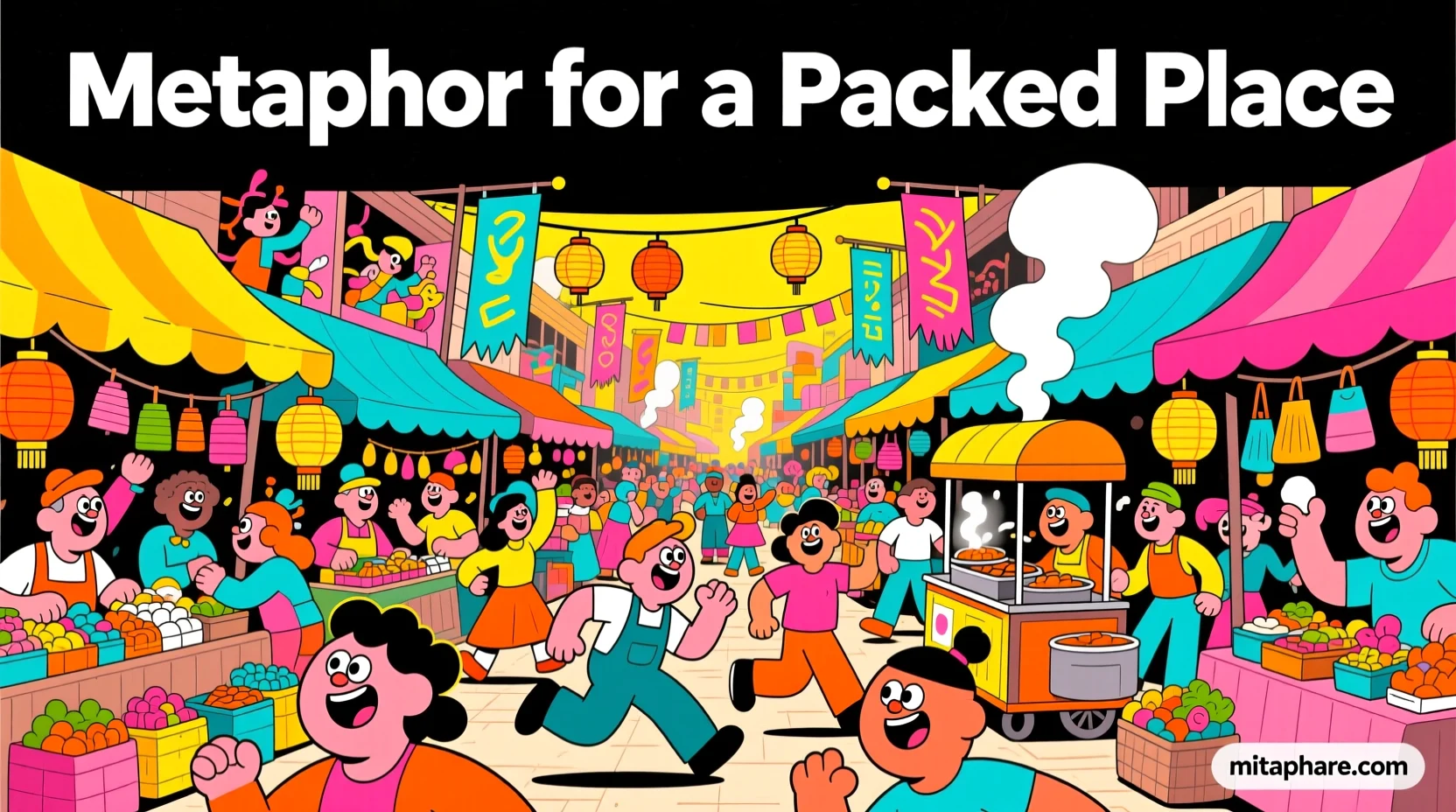
Let’s be honest—you and I have both walked into places so packed that we instantly thought, “Nope… this isn’t happening.” Maybe it was a market, a bus, a wedding hall, or a mall on a Sunday. And in that moment, you probably wished you had the perfect words to describe just how crowded it felt.
That’s exactly what we’re doing today.
I want to talk to you directly—face to face—like we’re sitting together and laughing about these chaotic, people-overflowing spaces. So if you’ve ever struggled to describe a packed place in a fun, vivid way, this list of metaphors will give you strong, visual, memorable options you can use in conversations, essays, or creative writing.
Let’s jump right in.
1. “The room was a can of sardines.”
Meaning: Extremely cramped and overcrowded.
Explanation: Just like sardines tightly packed in a metal can, people are squeezed together with no space.
Examples:
- “The bus at 8 a.m. was a can of sardines.”
- “The lift turned into a can of sardines after the fourth floor.”
2. “The hall was a human ocean.”
Meaning: A huge mass of people flowing together.
Explanation: This compares people to waves moving in every direction.
Examples:
- “The festival entrance looked like a human ocean.”
- “We pushed through a human ocean just to reach the gate.”
3. “The mall felt like a beehive.”
Meaning: Busy, noisy, and full of activity.
Explanation: A beehive is always buzzing—just like the crowd.
Examples:
- “The food court was a beehive at lunchtime.”
- “The station turned into a beehive during the holiday rush.”
4. “The market was a boiling pot.”
Meaning: So full it felt like it might overflow.
Explanation: A pot boiling over symbolizes chaos and activity.
Examples:
- “The street bazaar was a boiling pot of shoppers.”
- “The hall became a boiling pot as soon as the sale started.”
5. “It was a people jungle.”
Meaning: Wild, dense, and overwhelming.
Explanation: Just like a jungle is full of plants, a packed place is full of people.
Examples:
- “The corridor turned into a people jungle after the seminar.”
- “Navigating that people jungle took 30 minutes.”
6. “The room was bursting at the seams.”
Meaning: A place filled beyond capacity.
Explanation: Like cloth stretched so far it’s about to rip.
Examples:
- “The café was bursting at the seams during the rain.”
- “Our classroom felt bursting at the seams today.”
7. “The station was an ant colony.”
Meaning: Constant movement of many tiny figures.
Explanation: People resemble thousands of ants moving in lines.
Examples:
- “The train station looked like an ant colony.”
- “During rush hour, the lobby becomes an ant colony.”
8. “The restaurant was a traffic jam of bodies.”
Meaning: Movement is slow and stuck.
Explanation: A metaphor linking human congestion to car congestion.
Examples:
- “The buffet line was a traffic jam of bodies.”
- “The hallway turned into a traffic jam of bodies after the show.”
9. “The park was a sea of faces.”
Meaning: A huge crowd where you mostly notice heads and faces.
Explanation: The visual resembles a wide ocean.
Examples:
- “The rally was a sea of faces.”
- “At the concert, all I saw was a sea of faces.”
10. “The shop was a pressure cooker.”
Meaning: Hot, crowded, and stressful.
Explanation: Pressure builds in a cooker just like discomfort builds in a tight crowd.
Examples:
- “The discount aisle turned into a pressure cooker.”
- “Standing in that pressure cooker was exhausting.”
11. “The hallway was a river of people.”
Meaning: A nonstop flow in one direction.
Explanation: People move like water currents.
Examples:
- “Students created a river of people after class.”
- “The exit was just a river of people.”
12. “The place felt like rush-hour lungs.”
Meaning: Overfilled, strained, and hard to breathe.
Explanation: Lungs at capacity symbolize tight spaces.
Examples:
- “The metro felt like rush-hour lungs.”
- “I walked into rush-hour lungs at the club.”
13. “The beach looked like spilled confetti.”
Meaning: People scattered everywhere in large numbers.
Explanation: Confetti covers space with colorful fragments.
Examples:
- “The festival ground was spilled confetti.”
- “The picnic area looked like spilled confetti of families.”
14. “The café was a packed puzzle.”
Meaning: People fit together tightly like puzzle pieces.
Explanation: No gaps—just bodies aligned.
Examples:
- “Finding a seat in that packed puzzle was impossible.”
- “The hall arranged itself into a packed puzzle.”
15. “The bus was a stuffed suitcase.”
Meaning: Overloaded beyond its intended capacity.
Explanation: A bulging suitcase shows how crowded the space feels.
Examples:
- “The van was a stuffed suitcase by 8 a.m.”
- “We squeezed into a stuffed suitcase of a bus.”
16. “The stadium was a roaring forest.”
Meaning: A dense, loud crowd.
Explanation: People resemble trees and cheers resemble wind.
Examples:
- “The team entered a roaring forest of fans.”
- “The stands turned into a roaring forest during the chant.”
17. “The hallway was human spaghetti.”
Meaning: Tangled, twisted, and tightly packed.
Explanation: People close together look like strands.
Examples:
- “The crowd became human spaghetti near the door.”
- “We were stuck in human spaghetti for ten minutes.”
18. “The room was a popcorn machine.”
Meaning: Busy, jumpy, chaotic movement.
Explanation: Like popcorn popping everywhere, people keep shifting.
Examples:
- “The kids’ party was a popcorn machine.”
- “The lobby turned into a popcorn machine when the doors opened.”
19. “The plaza was a melting candle.”
Meaning: Crowds collapsing inward and flowing tightly.
Explanation: Like wax running down in heavy streams.
Examples:
- “The crowd moved like a melting candle toward the stage.”
- “The entrance became a melting candle of people.”
20. “The shop was a squeezed lemon.”
Meaning: Empty of space, full of pressure.
Explanation: A squeezed lemon has no room left inside—just like a jam-packed store.
Examples:
- “The bakery was a squeezed lemon on Sunday.”
- “We walked into a squeezed lemon of a pharmacy.”
Conclusion
Describing a crowded place doesn’t have to feel boring or repetitive. With the right metaphor, you can paint a picture so vivid that the reader instantly feels the chaos, movement, and energy of the scene. Whether it’s a “can of sardines,” a “river of people,” or a “boiling pot,” each metaphor gives you a fresh, powerful way to express how tightly packed a place is.
Now that you have 20 creative metaphors—with meanings, explanations, and examples—you’re fully equipped to bring your writing to life. Use them in essays, storytelling, conversations, or anywhere you want strong imagery that makes your words stand out.
And remember: the more creative your metaphors, the more memorable your message becomes.
If you want help writing similar metaphor guides, crafting visuals, or generating SEO-friendly content, just let me know—I’m here to help!
Practical Exercise (with Answers)
Choose the correct metaphor based on the situation.
1. A bus so crowded people can’t move.
Answer: A can of sardines
2. A nonstop flowing corridor after class.
Answer: A river of people
3. A market buzzing with shoppers everywhere.
Answer: A beehive
4. A stadium filled with cheering fans.
Answer: A roaring forest
5. A shop so tight it feels like the walls will pop.
Answer: Bursting at the seams
6. A festival where people stretch as far as the eye can see.
Answer: A sea of faces
7. A chaotic kids’ event with constant movement.
Answer: A popcorn machine
8. An environment where movement is blocked like stuck cars.
Answer: A traffic jam of bodies
9. A floor where people are tangled in every direction.
Answer: Human spaghetti
10. A holiday mall overloaded with people.
Answer: A boiling pot

Adem Julian is a writer at Mitaphare.com, where he crafts engaging articles about metaphors, language, and creative expression. His work helps readers see everyday ideas in fresh and meaningful ways.